Introduction
Modern IT systems are no longer simple or isolated. Today’s enterprises run applications across cloud platforms, microservices architectures, hybrid environments, and distributed infrastructure. This complexity generates massive volumes of operational data, including logs, metrics, alerts, and traces.
Traditional IT operations teams struggle to manually manage this scale of information. Issues often go unnoticed until they impact users, and diagnosing root causes can take hours or even days.
AIOps (Artificial Intelligence for IT Operations) is changing this landscape by introducing intelligence, automation, and predictive capabilities into IT operations. It uses machine learning and data analytics to detect anomalies, correlate events, and automate responses across complex infrastructures.
This blog explores how AIOps is transforming IT operations, why it is essential for modern enterprises, and how it improves reliability, performance, and efficiency.
What Is AIOps in Simple Terms?
AIOps is the application of artificial intelligence and machine learning to IT operations.
Instead of manually monitoring systems and reacting to problems, AIOps platforms automatically:
- Analyze operational data in real time
- Detect unusual patterns or anomalies
- Correlate related alerts
- Identify root causes of incidents
- Trigger automated remediation actions
In simple terms, AIOps helps IT teams move from reactive problem-solving to proactive and predictive operations.
Why IT Operations Need AI Today
Modern IT environments create challenges that traditional monitoring tools cannot handle effectively.
1. Explosion of Data
Systems generate huge volumes of logs, metrics, and events every second.
2. Alert Overload
Teams receive thousands of alerts, many of which are redundant or non-critical.
3. Complex System Dependencies
Applications depend on multiple services, APIs, containers, and cloud components.
4. Faster Business Expectations
Downtime is no longer acceptable, even for a few minutes.
5. Limited Human Capacity
IT teams cannot manually analyze every signal in real time.
AIOps solves these problems by automating analysis and decision-making.
How AIOps Works Behind the Scenes
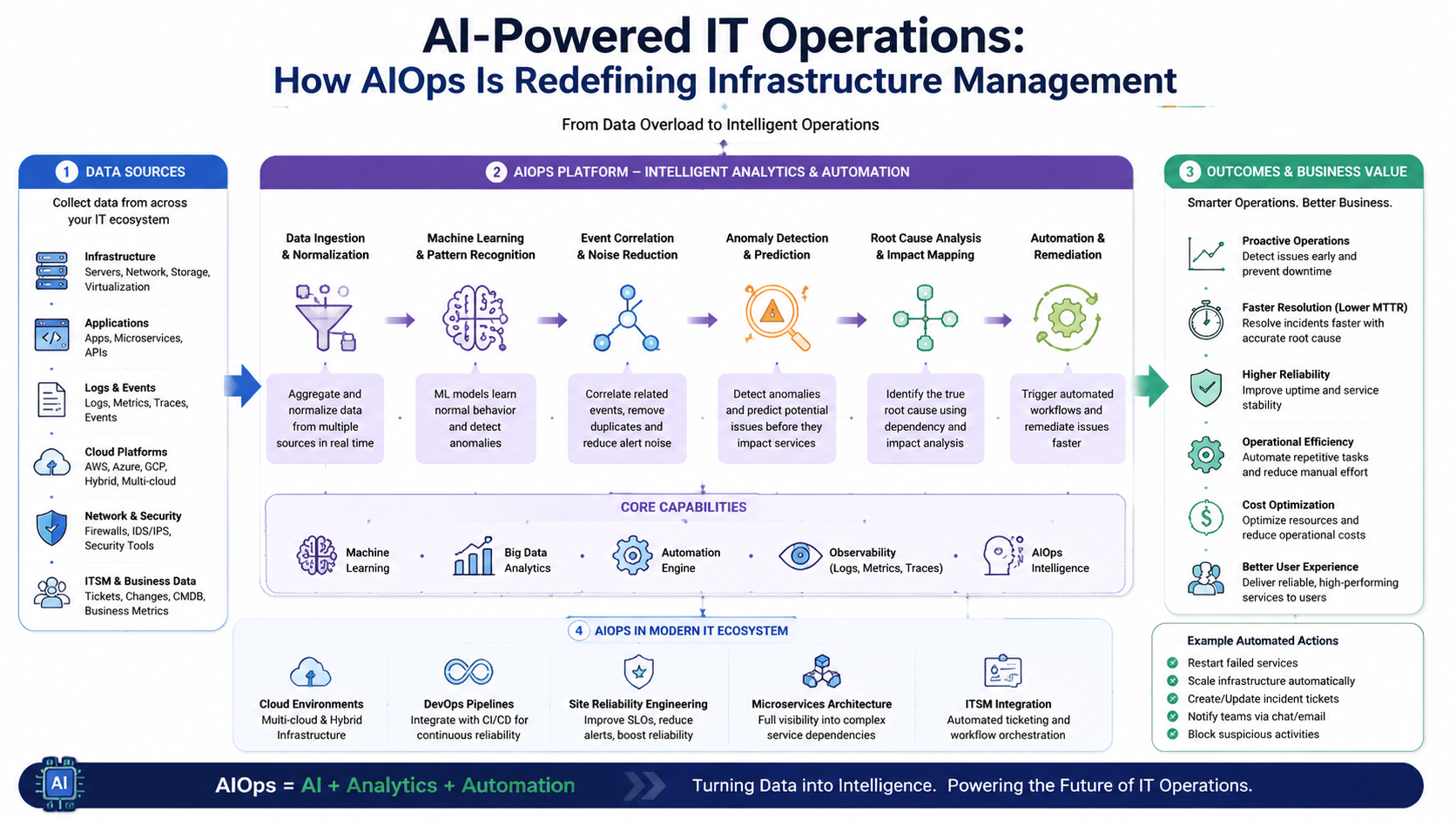
AIOps platforms typically follow a structured workflow to transform raw data into actionable insights.
Step 1: Data Collection
Data is gathered from multiple sources:
- Servers and infrastructure tools
- Cloud platforms
- Applications and microservices
- Logs and monitoring systems
- Security and network tools
Step 2: Data Normalization
The system organizes and standardizes data so it can be analyzed together.
Step 3: Machine Learning Processing
AI models analyze patterns to:
- Detect anomalies
- Identify trends
- Learn normal system behavior
Step 4: Event Correlation
Related alerts are grouped together to eliminate noise and duplication.
Step 5: Root Cause Identification
The system determines the most likely cause of an incident using dependency mapping.
Step 6: Automated Response
AIOps can trigger workflows such as:
- Restarting services
- Scaling infrastructure
- Sending alerts to teams
- Creating incident tickets
Core Capabilities of AIOps
AIOps platforms combine several powerful technologies:
Machine Learning Intelligence
Learns system behavior and detects deviations automatically.
Big Data Processing
Handles massive volumes of operational data in real time.
Advanced Analytics
Provides insights into system performance and reliability.
Automation Engine
Executes predefined or AI-driven remediation actions.
Observability Integration
Connects logs, metrics, and traces for complete visibility.
Key Benefits of AIOps
Faster Problem Detection
Issues are identified before they impact users.
Reduced Mean Time to Resolution (MTTR)
Root cause analysis becomes faster and more accurate.
Improved System Reliability
Predictive insights help prevent failures.
Lower Operational Costs
Automation reduces manual workload.
Better Resource Utilization
Optimizes infrastructure usage in real time.
Enhanced Customer Experience
Stable systems ensure better user satisfaction.
Real-World Applications of AIOps
Incident Management
Automatically detects and prioritizes incidents based on severity.
Predictive Maintenance
Predicts system failures before they occur.
Cloud Optimization
Helps manage and optimize cloud infrastructure usage.
Performance Monitoring
Identifies bottlenecks in applications and services.
Security Intelligence
Detects unusual behavior that may indicate threats.
Capacity Planning
Forecasts future infrastructure needs based on usage trends.
AIOps in Modern IT Ecosystems
Cloud Environments
Supports multi-cloud and hybrid infrastructure management.
DevOps Pipelines
Integrates with CI/CD for faster issue resolution.
Site Reliability Engineering
Enhances reliability through automation and predictive analysis.
Microservices Architecture
Manages complex service dependencies effectively.
Popular AIOps Platforms
Some widely used AIOps tools include:
- Dynatrace
- Datadog
- Splunk IT Service Intelligence
- New Relic
- IBM Cloud Pak for AIOps
- Moogsoft
- PagerDuty AIOps
- BigPanda
- LogicMonitor
- AppDynamics
These platforms help organizations implement AI-driven operations at scale.
Challenges in Adopting AIOps
Data Integration Issues
Combining multiple data sources can be complex.
Skill Requirements
Teams need knowledge of AI, analytics, and automation.
Cultural Shift
Moving from manual to automated operations requires mindset change.
Initial Setup Complexity
Implementation may take time and planning.
Future of AIOps
AIOps is rapidly evolving with new advancements such as:
- Generative AI for operations support
- Fully autonomous IT systems
- Self-healing infrastructure
- AI-driven DevOps pipelines
- Predictive and preventive IT operations
In the future, IT systems will become increasingly self-managing and intelligent.
Conclusion
AIOps is transforming IT operations by introducing intelligence, automation, and predictive capabilities into infrastructure management. It enables organizations to move beyond reactive troubleshooting toward proactive and self-healing systems.
As IT environments continue to grow in complexity, AIOps will become a critical foundation for maintaining performance, reliability, and scalability. Organizations that adopt AIOps early will benefit from reduced downtime, improved efficiency, and better overall user experience.
