Chennai is the capital city of Tamil Nadu.
It is one of the major cities in South India.
The city sits beside the Bay of Bengal. This gives Chennai a strong coastal identity.
But Chennai is much more than a beach city.
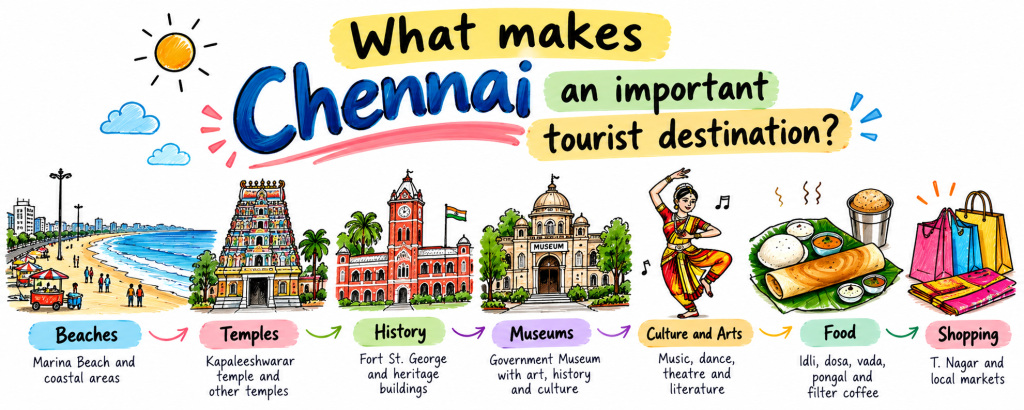
It has old temples, historic buildings, museums, art spaces, busy markets, local food, and modern city life.
The city also shows many parts of Tamil culture.
Visitors can enjoy classical music and dance. They can explore old temples and churches. They can walk along Marina Beach. They can also visit museums and historic sites.
The Chennai District Government describes the city as a gateway to South Indian culture. It also highlights its architecture, music, dance, drama, sculpture, arts, and crafts.
This mix makes Chennai an important tourist destination.
It gives visitors many ways to understand South India.
Why Is Chennai Important for Tourism?
Chennai has a strong mix of nature, history, culture, and city life.
A visitor can start the morning at Marina Beach.
Later, they can visit a temple.
In the afternoon, they can explore a museum.
In the evening, they can enjoy local food or a cultural show.
This makes Chennai useful for different types of travellers.
Chennai Tourism at a Glance
| Travel Interest | What Chennai Offers |
|---|---|
| Beaches | Marina Beach and other coastal areas |
| Temples | Kapaleeshwarar Temple and other temples |
| History | Fort St. George and old buildings |
| Museums | Government Museum and other museums |
| Culture | Music, dance, art, and festivals |
| Architecture | Temples, churches, forts, and heritage buildings |
| Food | South Indian meals and local snacks |
| Shopping | Markets, crafts, textiles, and local goods |
| Family Travel | Museums, beaches, parks, and cultural places |
| Nearby Trips | Mahabalipuram and other Tamil Nadu destinations |
The city gives visitors both old and new experiences.
That balance is one reason Chennai remains important for tourism.
1. Marina Beach Gives Chennai a Strong Coastal Identity
Marina Beach is one of Chennai’s most famous places.
It lies along the Bay of Bengal.
The Chennai District Government describes Marina Beach as nearly 12 kilometres long. It stretches from the Besant Nagar side toward Fort St. George.
The beach is active in the morning and evening.
People walk along the shore.
Families spend time together.
Local sellers offer food and small items.
Visitors can also enjoy the sunrise and sunset.
Things to do around Marina Beach
- Walk along the beach
- Watch the sunrise
- Enjoy the evening view
- Try local snacks
- Take photographs
- See nearby statues
- Explore nearby historic buildings
- Visit nearby attractions
The sea can have strong currents.
Visitors should avoid entering the water without proper guidance.
So, Marina Beach is best enjoyed with care.
2. Marina Beach Also Connects Tourism With History
Marina Beach is not only about sand and sea.
Several important buildings stand near the beach road.
These include:
- Chepauk Palace
- Senate House
- Presidency College
- University of Madras
- Other historic buildings
The beach also has many public statues.
These include statues of important writers, leaders, and cultural figures.
This makes a visit to Marina Beach more interesting.
You can enjoy nature and history in the same area.
That is useful for travellers who have limited time.
3. Chennai Has a Deep Temple Tradition
Chennai has many temples.
These temples show Tamil culture through architecture, stories, festivals, and daily worship.
One of the best-known temples is Kapaleeshwarar Temple in Mylapore.
The temple is known for its Dravidian style.
Its colourful entrance tower is easy to recognize.
Visitors can also explore the streets around Mylapore.
The area has shops, food places, small temples, and local markets.
This makes Mylapore more than a single tourist attraction.
It offers a look at everyday Chennai life.
4. Kapaleeshwarar Temple Shows Dravidian Architecture
Kapaleeshwarar Temple is an important cultural stop in Chennai.
The temple’s design shows the rich tradition of South Indian temple architecture.
The tall gopuram attracts attention from a distance.
The carvings also show many figures and stories.
Visitors who enjoy architecture can spend time looking at these details.
People should remember that the temple remains an active place of worship.
So, visitors should dress with care.
They should also follow temple rules.
Photography rules may vary inside different areas.
5. Chennai Has a Strong Connection With Tamil Literature
Chennai also has an important literary identity.
The city celebrates Tamil writers and poets.
One famous landmark is Valluvar Kottam.
The memorial honours Thiruvalluvar.
He is famous for the Tirukkural, a classic Tamil work.
The Chennai District Government says Valluvar Kottam was built in his honour. It also describes its temple-car-inspired design and engraved Tirukkural couplets.
Visitors can learn about Tamil literature through this site.
The building also shows how literature can shape public architecture.
6. Valluvar Kottam Combines Literature and Architecture
Valluvar Kottam has a large stone structure.
Its design draws from the traditional temple chariot style.
The site also contains inscriptions related to the Tirukkural.
This gives visitors two experiences.
They can learn about Tamil literature.
They can also study the building’s design.
For students, the site can make a history or literature lesson more visual.
For tourists, it adds another side to Chennai.
7. Fort St. George Shows Chennai’s Colonial History
Fort St. George is another major historic place.
The fort has played an important role in Chennai’s history.
It also connects the city with the period of British rule in India.
The Chennai District Government describes the fort as a historic stronghold with high walls. The complex includes the Fort Museum and St. Mary’s Church.
Visitors interested in history can learn about the city’s colonial past here.
The fort also helps explain how Chennai developed as an important port city.
8. St. Mary’s Church Adds Another Historic Layer
St. Mary’s Church stands inside the Fort St. George complex.
The Chennai District Government describes it as the oldest Anglican church in India. It was built between 1678 and 1680.
The church has historic tombstones.
It also connects with important people from the colonial period.
This gives visitors another way to understand Chennai’s past.
The fort and church work well together in one heritage visit.
9. Government Museum Makes Chennai Important for History Lovers
Chennai has one of India’s major historic museums.
The Government Museum is in Egmore.
The museum began in 1851.
The Chennai District Government describes it as the second-oldest museum in India. It also says the complex covers 16.25 acres and has 46 galleries across six buildings.
The museum covers many subjects.
These include:
- Archaeology
- Anthropology
- Art
- Bronze works
- Natural history
- Botany
- Zoology
- Numismatics
- Sculpture
This makes it useful for many types of visitors.
10. The Government Museum Has Many Different Galleries
The museum is not one single room.
It has several sections.
Visitors can see sculptures and old objects.
They can explore bronze works.
They can learn about natural history.
There is also a children’s section.
The museum includes an art gallery and other cultural spaces.
This variety makes the museum useful for families.
Parents can introduce children to history through real objects.
Students can also learn beyond school books.
11. Chennai Is Important for South Indian Art
Chennai has a strong connection with Indian classical arts.
The city has long supported:
- Carnatic music
- Bharatanatyam
- Classical concerts
- Theatre
- Traditional crafts
- Tamil literature
The Chennai District Government highlights music, dance, drama, sculpture, arts, and crafts as important parts of the city’s cultural identity.
This makes Chennai attractive to culture lovers.
A tourist can experience art through performances.
They can also see art in temples and museums.
12. Bharatanatyam Adds Cultural Value
Bharatanatyam is a major classical dance tradition from Tamil Nadu.
Chennai plays an important role in its performance and teaching.
The dance uses hand movements, facial expressions, rhythm, and body movement.
A live performance gives visitors a better sense of this art.
Tourists should check local event schedules before planning a cultural evening.
Events can change by season and venue.
13. Carnatic Music Gives Chennai a Unique Identity
Chennai is also well known for Carnatic music.
Many music events take place across the city.
The city becomes especially active during the annual music and dance season.
Visitors who enjoy classical music can look for public concerts and cultural programs.
A live concert can help visitors understand South Indian musical traditions.
It also adds something different from normal sightseeing.
14. Chennai Has a Strong Food Culture
Food is another major part of Chennai tourism.
The city offers many South Indian dishes.
Popular choices include:
- Idli
- Dosa
- Vada
- Pongal
- Sambar
- Rasam
- Curd rice
- Filter coffee
- South Indian meals
Different restaurants serve these dishes in different styles.
Some use traditional banana leaves.
Others offer modern versions.
Trying local food can become an important part of the trip.
15. Filter Coffee Is Part of the Chennai Experience
South Indian filter coffee is popular in Chennai.
The drink uses brewed coffee and milk.
Many local restaurants serve it after meals.
It can also become a simple way to experience local food culture.
Visitors can pair coffee with dishes such as idli, vada, or dosa.
Small food stops can sometimes tell you more about a city than a long sightseeing list.
16. Chennai Has Interesting Shopping Areas
Shopping can add another layer to a Chennai trip.
The city has large markets and local shopping streets.
Visitors can look for:
- Silk sarees
- Cotton clothes
- Traditional jewellery
- Handicrafts
- Brass items
- Local snacks
- Books
- Art products
T. Nagar is one of the city’s well-known shopping areas.
It is especially known for clothing and jewellery.
Visitors should compare prices before buying.
They should also check product quality.
17. Mylapore Shows Everyday Chennai Life
Mylapore is one of Chennai’s well-known cultural areas.
The neighbourhood combines temples, old streets, markets, food, and daily life.
Kapaleeshwarar Temple is one of its major landmarks.
But the streets around the temple also matter.
Visitors can see local shops.
They can try traditional food.
They can observe daily temple activity.
This makes Mylapore useful for travellers who want more than famous monuments.
18. Chennai Has Many Historic Churches
Chennai’s history includes different faiths and communities.
The city has several old churches.
San Thome Basilica is one of the best-known examples.
It stands near the coast.
The site has religious and historical importance.
Visitors interested in architecture can also study its design.
As with temples and mosques, visitors should respect local religious customs.
19. Chennai Offers Modern City Experiences Too
Chennai is not only an old heritage city.
It is also a major modern city.
Visitors can find:
- Shopping malls
- Modern restaurants
- Cafes
- Art spaces
- Hotels
- Business districts
- Entertainment venues
- Modern transport
This creates a balance.
A visitor can explore an old temple in the morning.
Later, they can enjoy a modern café.
That mix makes Chennai easy to enjoy for different age groups.
20. Chennai Has Places for Family Travel
Families can choose from several types of activities.
Museums can provide educational value.
Beaches give children open space.
Temples can introduce architecture and culture.
Science and educational attractions can make learning more fun.
A family can also build a simple day around one area.
This avoids spending too much time in traffic.
21. Chennai Is Useful for Educational Travel
Students can learn many things through a Chennai trip.
A single visit can cover:
History
Architecture
Literature
Science
Art
Religion
Geography
Food culture
The Government Museum is especially useful for educational visits.
Its collections cover archaeology, anthropology, natural history, art, and other fields.
This makes Chennai more than a leisure destination.
It can also work as a learning destination.
22. Chennai Shows Many Layers of History
Chennai’s history did not develop in one period.
Different communities and rulers shaped the city.
You can see this through:
- Temples
- Churches
- Forts
- Markets
- Museums
- Memorials
- Heritage buildings
- Literary landmarks
This creates a layered travel experience.
One neighbourhood may show traditional Tamil culture.
Another may show colonial history.
A modern area may show today’s Chennai.
23. Chennai’s Coastal Location Adds More Value
The Bay of Bengal shapes Chennai’s identity.
The coast affects local food.
It also influences trade and daily life.
Marina Beach is the most visible example.
The coast also gives visitors places to relax.
But visitors should respect sea conditions.
Strong currents can make swimming risky.
Enjoying the coast does not require entering the water.
A walk can be enough.
24. Chennai Can Be a Base for Nearby Travel
Chennai also works as a starting point for wider Tamil Nadu travel.
Visitors can plan trips toward places such as:
- Mahabalipuram
- Kanchipuram
- Pondicherry
- Pulicat
- Other nearby destinations
Travel times depend on traffic and route.
So, visitors should check current road conditions.
A longer Tamil Nadu trip can start in Chennai.
25. Mahabalipuram Adds Heritage to a Chennai Trip
Mahabalipuram is known for its stone monuments and coastal setting.
It is a strong choice for travellers interested in South Indian architecture.
The monuments show the skill of ancient stone workers.
Visitors can see temples, carvings, and rock-cut structures.
This makes Mahabalipuram a useful addition to a Chennai itinerary.
It also shows how Chennai can connect travellers with the wider heritage of Tamil Nadu.
26. Kanchipuram Adds Temple and Silk Experiences
Kanchipuram is another useful nearby destination.
It is known for temples and silk traditions.
Visitors interested in South Indian temple architecture can spend time exploring the city.
Those interested in textiles can also learn about Kanchipuram silk.
A Chennai trip can therefore become part of a larger cultural journey.
27. Chennai Is Good for Short Trips
You do not need a long holiday to enjoy Chennai.
A two-day trip can cover several key experiences.
Example 2-Day Chennai Plan
| Day | Morning | Afternoon | Evening |
|---|---|---|---|
| Day 1 | Marina Beach | Government Museum | Mylapore |
| Day 2 | Fort St. George | Valluvar Kottam | Local food and shopping |
This plan gives you:
- Nature
- History
- Culture
- Food
- Shopping
You can change the order based on opening hours.
28. Example 3-Day Chennai Plan
A three-day trip gives more space.
| Day | Main Area | Main Experience |
|---|---|---|
| Day 1 | Marina and Fort | Beach and history |
| Day 2 | Egmore and Mylapore | Museum and temple culture |
| Day 3 | Local city areas | Shopping, food, and culture |
You can also replace Day 3 with a nearby trip.
Mahabalipuram can work well for travellers interested in heritage.
29. A Simple Chennai Trip for Families
Families can use a slower plan.
Morning
Start with a beach or museum.
Afternoon
Have lunch and rest.
Evening
Visit a cultural or shopping area.
This plan avoids too much travel.
It also gives children time to rest.
Parents can choose attractions based on age and interest.
30. A Simple Chennai Trip for Culture Lovers
Culture-focused travellers can create a different route.
Suggested route
Mylapore
↓
Kapaleeshwarar Temple
↓
Valluvar Kottam
↓
Government Museum
↓
Cultural performance
This route focuses on Tamil culture, literature, architecture, and art.
It gives a deeper view of the city.
31. A Simple Chennai Trip for History Lovers
History lovers can focus on older sites.
Suggested route
Fort St. George
↓
St. Mary’s Church
↓
Fort Museum
↓
Government Museum
↓
Historic Marina area
This route shows different parts of Chennai’s past.
It also reduces the need to travel across the entire city.
32. Chennai Offers Many Travel Styles
Different travellers can enjoy Chennai in different ways.
| Traveller Type | Good Starting Points |
|---|---|
| Family | Marina, museums, cultural sites |
| History lover | Fort St. George, museums |
| Culture lover | Mylapore, Valluvar Kottam |
| Food lover | Local restaurants and markets |
| Beach lover | Marina and coastal areas |
| Architecture lover | Temples, churches, forts |
| Student | Museums and heritage sites |
| Shopper | T. Nagar and local markets |
| Photographer | Marina, temples, old buildings |
This flexibility is one of Chennai’s useful tourism features.
33. Chennai’s Climate Should Shape Your Plan
Chennai has a warm climate.
Outdoor activities can feel tiring during the hottest part of the day.
So, plan outdoor visits carefully.
Early morning can work well for beaches.
Indoor museums can work better during hotter hours.
Evening can suit markets and food walks.
Always check the current weather before travel.
34. Plan Around Traffic
Chennai is a large city.
Traffic can affect travel time.
A place that looks close on a map may take longer to reach.
This matters when planning several attractions.
Try to group nearby places together.
For example:
Marina + Fort St. George
can fit into one broad sightseeing plan.
Similarly:
Mylapore + Kapaleeshwarar Temple
can work well together.
Good planning saves time.
35. Check Timings Before Visiting
Attraction timings can change.
Some places may close on certain days.
Museums can have fixed hours.
Religious places may have different visitor rules.
For example, the Chennai District Government lists specific public timings for the Government Museum.
So, check official information before leaving your hotel.
This simple step can prevent wasted travel time.
36. Respect Religious Places
Chennai has many active religious sites.
Visitors should treat them as places of worship.
Follow signs.
Dress respectfully.
Keep noise low.
Ask before taking photographs.
Remove footwear where required.
Do not enter restricted areas.
These simple actions show respect for local culture.
37. Be Careful Near the Sea
Marina Beach is beautiful.
But the sea can be dangerous.
The Chennai District Government warns about strong undercurrents at Marina.
So, visitors should not treat the beach like a swimming pool.
Stay within safe areas.
Follow local warnings.
Keep children close.
Avoid entering the water during unsafe conditions.
A safe beach visit is a better beach visit.
38. Try Local Food With Care
Local food is an important part of Chennai travel.
But food hygiene still matters.
Choose busy places with good hygiene.
Drink safe water.
Be careful with food that has been sitting outside for a long time.
If you have food allergies, ask about ingredients.
This is especially useful when trying unfamiliar dishes.
39. Chennai Is More Than Its Famous Landmarks
Tourists often focus on famous places.
But Chennai has value beyond its major attractions.
The local streets matter.
The food matters.
The markets matter.
The people and daily life matter.
A short walk around a traditional neighbourhood can reveal things that a landmark cannot.
This is why slow exploration can improve a Chennai trip.
40. What Makes Chennai Different?
Many Indian cities have beaches.
Many have temples.
Many have museums.
Many have historic buildings.
Chennai brings all these elements together.
It also connects them with Tamil language, art, food, music, dance, and literature.
That combination gives the city a strong cultural identity.
The Chennai District Government itself describes the city as an important centre for South Indian culture and arts.
41. Chennai Tourism Decision Table
| If You Want | Consider |
|---|---|
| A beach experience | Marina Beach |
| Tamil culture | Mylapore |
| Literature | Valluvar Kottam |
| Colonial history | Fort St. George |
| Museum visit | Government Museum |
| Temple architecture | Kapaleeshwarar Temple |
| Shopping | T. Nagar |
| Local food | Traditional restaurants |
| Classical arts | Music and dance events |
| Nearby heritage | Mahabalipuram |
This table can help first-time visitors build a simple plan.
42. Common Mistakes Tourists Should Avoid
Mistake 1: Visiting too many places in one day
Chennai is large.
Do not create an unrealistic schedule.
Mistake 2: Ignoring traffic
Travel time can change during busy hours.
Mistake 3: Planning outdoor activities at noon
Morning and evening can feel more comfortable.
Mistake 4: Ignoring sea warnings
Strong currents can make swimming unsafe.
Mistake 5: Treating temples as normal tourist sites
Remember that many remain active places of worship.
Mistake 6: Forgetting local food
Food can be an important part of the Chennai experience.
Mistake 7: Not checking opening hours
Always check current information before travelling.
43. A Practical Chennai Travel Checklist
Before your trip, check:
- Hotel location
- Airport or train arrival
- Local transport
- Attraction timings
- Weather
- Temple rules
- Museum timings
- Beach safety
- Food options
- Nearby travel plans
Keep your daily plan flexible.
This matters because city traffic and weather can change your schedule.
44. How to Plan a Better Chennai Trip
Use a simple method.
Step 1: Pick your main interest
Choose culture, history, food, beaches, or shopping.
Step 2: Choose nearby attractions
Group places that sit close together.
Step 3: Check timings
Do this before leaving.
Step 4: Plan travel time
Add extra time for city traffic.
Step 5: Leave free time
Do not fill every hour.
Step 6: Try local food
Choose safe and trusted places.
Step 7: Respect local customs
Follow rules at cultural and religious sites.
This simple approach can make the trip easier.
45. Why Chennai Works for Different Ages
Children can enjoy beaches and museums.
Young travellers can enjoy food, shopping, and city life.
Adults can explore history and culture.
Older travellers can enjoy temples, museums, and relaxed sightseeing.
Families can mix these activities.
This makes Chennai a flexible destination.
46. Chennai as a Learning Destination
A Chennai trip can teach visitors many things.
You can learn about:
- Tamil literature
- South Indian architecture
- Colonial history
- Indian archaeology
- Classical dance
- Classical music
- Local food
- Coastal life
- Traditional crafts
This makes the city useful for educational tourism.
Students can connect classroom topics with real places.
47. Responsible Tourism in Chennai
Tourism works best when visitors protect the places they visit.
Visitors should:
- Avoid littering
- Use waste bins
- Respect beaches
- Follow museum rules
- Protect old buildings
- Respect religious sites
- Avoid disturbing local life
- Support local businesses
- Follow safety signs
Small actions can protect Chennai’s tourism value.
They also help keep the city pleasant for future visitors.
48. Final Thoughts
Chennai is important as a tourist destination because it offers many experiences in one city.
It has a long coastline.
It has historic forts.
It has old temples.
It has museums.
It has literature.
It has music and dance.
It has local food.
It has markets.
It also has a modern city side.
Marina Beach gives Chennai its strong coastal identity.
Fort St. George connects the city with colonial history.
The Government Museum gives visitors a deeper look at art, archaeology, and culture.
Valluvar Kottam connects the city with Tamil literature.
Together, these places show why Chennai offers more than a simple city break.
The best way to explore Chennai is to slow down.
Choose a few areas.
Group nearby attractions.
Try local food.
Spend time at the beach.
Visit a museum.
Explore a temple or heritage site.
Also leave some time for normal city life.
That balance can help visitors understand why Chennai remains an important tourist destination in South India.
Frequently Asked Questions
What makes Chennai an important tourist destination?
Chennai combines beaches, temples, museums, history, food, art, music, dance, literature, and modern city life. The city also acts as a gateway to South Indian culture.
What is Chennai most famous for?
Chennai is well known for Marina Beach, Tamil culture, temples, classical arts, food, museums, and historic buildings.
Why is Marina Beach important?
Marina Beach is one of Chennai’s best-known landmarks. The Chennai District Government describes it as nearly 12 kilometres long and highlights its sunrise, sunset, food stalls, statues, and nearby historic buildings.
What are the best tourist places in Chennai?
Popular places include Marina Beach, Fort St. George, Government Museum, Valluvar Kottam, Kapaleeshwarar Temple, Mylapore, and other cultural landmarks.
Is Chennai good for family trips?
Yes. Families can visit beaches, museums, cultural sites, parks, and shopping areas.
Is Chennai good for history lovers?
Yes. Fort St. George, the Government Museum, old buildings, temples, and churches provide many historical experiences.
Why is the Government Museum important?
The Government Museum began in 1851. It has collections covering archaeology, anthropology, art, natural history, bronze works, and other subjects.
What is Valluvar Kottam?
Valluvar Kottam is a memorial dedicated to the Tamil poet Thiruvalluvar. Its design draws from the traditional temple chariot and connects the site with the Tirukkural.
Is Chennai good for food lovers?
Yes. Visitors can try idli, dosa, vada, pongal, South Indian meals, filter coffee, and many other local dishes.
Is Chennai good for culture lovers?
Yes. Chennai has strong links with Tamil literature, Carnatic music, Bharatanatyam, temples, traditional crafts, and cultural events.
Can tourists visit Chennai for only two days?
Yes. A two-day trip can cover major areas such as Marina Beach, Fort St. George, Government Museum, Mylapore, and Valluvar Kottam.
Can Chennai be used as a base for nearby trips?
Yes. Visitors can plan trips to places such as Mahabalipuram and Kanchipuram, depending on available time.
Is swimming safe at Marina Beach?
Visitors should be careful. The Chennai District Government warns that Marina can have strong undercurrents. Follow local safety guidance and avoid entering the sea in unsafe conditions.
What should visitors check before travelling?
Check attraction timings, weather, transport, traffic, local rules, and sea safety information before starting each day.
Useful Chennai Tourism Resources
Chennai District Government – Tourism
Chennai Tourism Information
Chennai Tourist Places
Official Chennai Tourist Places
Chennai Places of Interest
Chennai Places of Interest
Government Museum
Government Museum Chennai
Marina Beach
Official Marina Beach Information
Hashtags
