Introduction
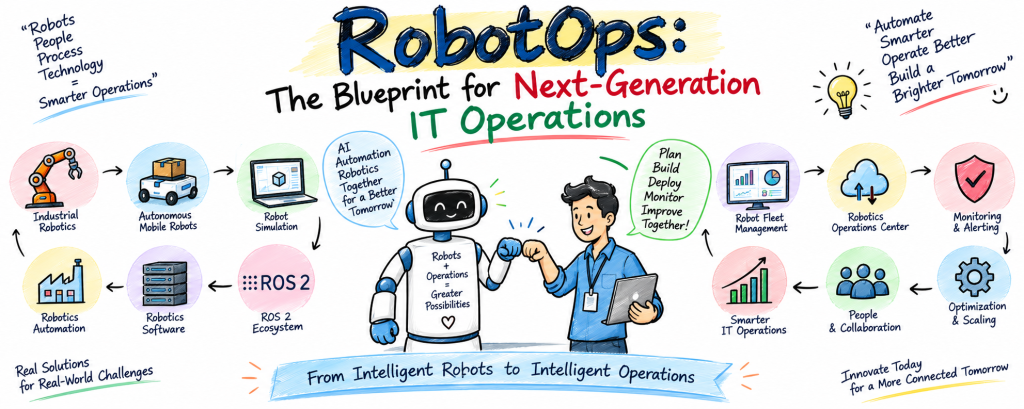
A robot can lift a box, check a product, or move around a factory. But the machine alone cannot manage its own work.
People need to write its software. They need to test changes. They must watch system health and fix errors.
This work creates the need for RobotOps.
RobotOps brings robotics, software, automation, testing, and monitoring into one working process. It helps teams manage robots from early development to daily use.
The field covers many areas. These areas include Robotics Operations, Robot Fleet Management, Industrial Robotics, Robotics Software, Robot Simulation, Autonomous Mobile Robots, Robotics Automation, Robotics Operations Center, and ROS 2.
RobotsOps.com gives learners and technical teams a place to explore these topics. The platform focuses on practical ideas that can help people understand modern robot systems.
You can explore RobotsOps.com at https://www.robotsops.com/.
The best learning path starts small. Pick one robot problem. Build a simple solution. Test it, watch the results, and improve your work.
1. RobotOps Brings Robotics and Software Together
Robotics once focused mainly on machines, motors, and control systems. Modern robots now depend heavily on software and data.
A robot may use cameras to see objects. Sensors can measure distance. Software can read that data and choose an action.
This creates a new challenge. Teams must manage both physical machines and software systems.
RobotOps helps solve that challenge.
A RobotOps team may handle software releases, robot health, logs, alerts, testing, and system updates.
For example, imagine a robot that moves packages. The robot suddenly stops near a loading area.
The team needs useful information. They may check its battery, network, sensors, software, and recent logs.
A good RobotOps process can make this work easier.
Beginners can start with:
- Linux
- Python
- Git
- Testing
- Basic robotics
- Monitoring
- ROS 2
- Simulation
Each skill adds value. Together, these skills create a strong RobotOps foundation.
2. Turn Robotics Operations Into a Clear Process
Running robots every day creates many tasks. Teams must check machines, manage software, study errors, and respond to problems.
Robotics Operations covers these daily jobs.
Imagine a factory with several robotic arms. One arm handles assembly. Another checks products. A third robot moves parts between work areas.
Each machine creates useful information.
Teams can track robot health, task status, software versions, sensor data, and errors.
A clear process helps workers act faster.
Start with basic monitoring. Check whether each robot works. Then track battery or power status where needed.
Next, add logs. Logs record useful events and help engineers understand problems.
After that, create alerts.
For example, an alert can tell an operator when a robot stops responding.
A simple operations process can include:
- Check robot health.
- Review important alerts.
- Read error logs.
- Track software versions.
- Handle incidents.
- Test updates.
- Review robot performance.
This approach helps teams move from reactive work to better daily control.
3. Manage Large Fleets With Better Tools
Managing one robot can feel simple. Managing hundreds of robots creates a different problem.
Robot Fleet Management helps teams handle many machines through shared systems.
A fleet dashboard can give operators one view of many robots. The dashboard can show robot names, locations, tasks, battery levels, errors, and software versions.
Think about a busy warehouse.
One robot may move a package. Another may wait for charging. A third may stop because of an obstacle.
An operator can check all three robots from one place.
You can build a small fleet project to learn this idea.
Start with two virtual robots. Give each robot a name and status.
Then add:
- Battery data
- Robot location
- Current task
- Connection status
- Error state
- Software version
- Last activity
Next, add simple alerts.
You can alert the operator when a robot loses connection or reports an error.
This project teaches the basic ideas behind Robot Fleet Management. It also shows why teams need central tools as fleets grow.
4. Discover Where Industrial Robotics Fits
Factories use robots for many repeat tasks. These tasks include assembly, welding, inspection, packaging, sorting, and material movement.
Industrial Robotics focuses on these machines and their work.
A robotic arm gives us an easy example. The arm can repeat a movement many times with careful control.
However, factory robots need more than movement.
Engineers must understand sensors, motors, controllers, software, safety systems, and work areas.
Suppose a robot checks product parts.
A camera can capture an image. Software can study the image. The system can then decide whether the part meets the required rules.
Each step needs careful design.
Safety also matters. Teams must understand where robots can move and how people can work near them.
Beginners can study common factory use cases first.
Look at:
- Assembly robots
- Welding robots
- Inspection robots
- Packing robots
- Sorting robots
- Material handling robots
Then study how these machines exchange data with other factory systems.
This method gives learners a wider view of Industrial Robotics.
5. Give Robotics Software Better Structure
Hardware gives a robot physical ability. Robotics Software gives that hardware instructions.
Software can control movement, read sensors, process camera data, plan routes, and manage tasks.
Modern robots often use many software parts.
One program may process camera information. Another may plan movement. A third may handle communication.
These parts must work together.
That makes testing very important.
Suppose an engineer changes navigation code. The change may affect how the robot moves around people or objects.
Teams should test such changes before they reach working robots.
Good software habits include:
- Track code with Git.
- Test every important change.
- Keep useful logs.
- Record software versions.
- Review major changes.
- Keep a recovery plan.
A recovery plan helps teams return to a known working version.
These habits also help software engineers enter robotics. They can bring familiar development skills into a new technical field.
6. Use Robot Simulation Before Physical Tests
Real robot testing can cost time and money. It can also need special equipment and safe space.
Robot Simulation gives engineers a virtual place to test ideas.
A simulation can contain robots, sensors, walls, roads, boxes, factory areas, and other objects.
Imagine a virtual warehouse.
A robot needs to move from a storage area to a packing area. You can place shelves and boxes in the virtual space.
Then you can test the robot path.
If the robot hits an obstacle or chooses a poor route, you can change the software and test again.
Beginners can follow this process:
- Create a simple virtual scene.
- Add a robot model.
- Add basic sensors.
- Test movement.
- Add obstacles.
- Watch the robot.
- Find problems.
- Change the software.
- Test again.
This method helps learners understand robot behavior.
It also gives engineering teams a useful way to test software before they move to physical machines.
7. Understand How Autonomous Mobile Robots Work
Autonomous Mobile Robots can move through spaces with limited direct control.
These robots use sensors, maps, software, and navigation systems. They can support work in warehouses, factories, hospitals, and other places.
A warehouse robot may carry a package from one location to another.
The robot needs to know where it is. It also needs to avoid obstacles and choose a safe route.
But navigation represents only one part of the job.
Teams must also manage battery levels, network connections, software updates, errors, and task status.
A careful software update process can reduce risk.
First, create the change. Next, test it in simulation. Then try it on one robot.
Watch the robot after the update. Check its tasks and logs.
If the robot performs well, expand the update to more machines.
This process gives teams more control over large groups of Autonomous Mobile Robots.
8. Build Useful Workflows With Robotics Automation
Many workplaces contain repeat tasks. Robotics Automation can help machines handle some of this work.
Start with the task, not the robot.
Ask what the worker does today. Then break that work into simple steps.
Imagine a robot that moves boxes.
It needs to find a box. It needs to reach the box. It needs to move the box to another location.
Each action needs a clear rule.
The system also needs rules for problems.
What should happen when the robot cannot find the box?
What should happen when another robot blocks the path?
What should happen when the network connection fails?
A practical workflow can follow these steps:
- Define the goal.
- Break the job into actions.
- Select suitable sensors.
- Create the control logic.
- Test each action.
- Add error handling.
- Track results.
- Improve the workflow.
This approach keeps automation focused on real needs.
It also helps teams understand how robotics and software work together.
9. Create a Central Robotics Operations Center
Large fleets produce a lot of data. Teams need a clear place to view important information.
A Robotics Operations Center can provide that central view.
Think of it as a control room for robots.
An operator can see robot health, battery levels, errors, software versions, tasks, and network status.
Suppose one robot stops sending data.
The operator can see the warning. Then the operator can check recent logs and other system details.
The team can use that information to decide what to do next.
A useful Robotics Operations Center can track:
- Robot health
- Fleet activity
- Battery status
- Network health
- Software releases
- Task progress
- Error messages
- Important alerts
Remote engineers can also review this data before they visit a machine.
This can help teams spend less time searching for basic information.
As robot fleets grow, a central operations center can become an important part of RobotOps.
10. Learn ROS 2 Through Simple Examples
ROS 2 gives robotics developers tools that help different software parts communicate.
Many beginners find ROS 2 large at first. A step-by-step approach makes it easier.
Start with a node.
A node handles one software task.
Next, learn about topics. Topics help software parts share ongoing information.
Then study services. Services handle short requests and responses.
After that, explore actions. Actions support longer tasks and can show progress.
Try this learning order:
- Create a simple node.
- Publish basic data.
- Read a topic.
- Call a service.
- Try an action.
- Read logs.
- Test the application.
For example, one node can read sensor information. Another node can use that information to control robot movement.
This small project shows how ROS 2 connects different software pieces.
Once you understand these basics, you can explore more advanced robotics applications.
11. Follow a Project-Based RobotOps Roadmap
Reading about RobotOps can help. Building projects can teach you much more.
Use a simple learning cycle:
Learn → Build → Test → Run → Monitor → Improve
Start with one small project.
For example, build a robot health dashboard.
Show the robot name, status, battery, task, and connection.
Next, add error messages.
Then add alerts.
After that, add more robots and turn the project into a small fleet dashboard.
You can also try other projects:
- Robot fleet tracker
- ROS 2 communication project
- Robot simulation project
- Robot health monitor
- Error alert system
- Software release tracker
- Robotics operations dashboard
Each project should solve a clear problem.
Ask:
- What does the robot do?
- What data does it create?
- What can fail?
- How can we detect the failure?
- How can we fix it?
These questions help learners think like RobotOps engineers.
12. Create Clear Content With AEO, GEO, LLMO, and AISEO
Technical readers want quick and clear answers. Search systems also need clear information.
That makes AEO, GEO, LLMO, and AISEO useful concepts for RobotOps content.
AEO means Answer Engine Optimization. It helps content answer direct questions clearly.
GEO means Generative Engine Optimization. It focuses on content that works well with generative search tools.
LLMO means Large Language Model Optimization. It encourages clear information that language models can understand.
AISEO means AI Search Optimization. It focuses on content for search experiences that use AI.
You can support these goals with simple writing.
Answer questions directly. Explain hard words. Add practical examples. Use useful headings.
Also, follow E-E-A-T.
Show experience. Share useful knowledge. Use trustworthy information. Give readers clear examples.
Strong RobotOps content can include:
- Step-by-step tutorials
- Real use cases
- Case studies
- Success stories
- Original insights
- Expert interviews
- Research data
- Detailed comparisons
- Practical examples
- Unique frameworks
Good content should help readers first. Search visibility should follow useful information.
Build Real Skills Through Small RobotOps Projects
Practical work can make difficult ideas easier.
You can start with a simple robot monitoring project. Track robot health, battery, connection, and task status.
Then add logs.
Next, add alerts for important errors.
After that, add another robot and create a fleet view.
You can also build a simulation project. Test movement, sensors, and obstacles inside a virtual environment.
Another option involves ROS 2. Create two nodes and let them share simple data.
You can study real-world use cases too.
Look at warehouse robots. Explore factory automation. Study inspection systems. Review autonomous machines.
For every example, ask five basic questions:
What problem does the robot solve?
What data does it create?
What can cause a failure?
How can the team find the failure?
How can the team recover?
These questions turn theory into practical thinking.
Frequently Asked Questions About RobotsOps.com
1. What does RobotOps mean?
RobotOps covers the work that helps teams build, run, monitor, update, and improve robot systems.
2. Who can learn RobotOps?
Students, software engineers, robotics engineers, DevOps engineers, automation professionals, and technology learners can study RobotOps.
3. What does Robot Fleet Management do?
Robot Fleet Management helps teams manage many robots through shared dashboards and tools.
4. Why does Robot Simulation help engineers?
Robot Simulation gives engineers a virtual space for testing robot software before physical testing.
5. What does Industrial Robotics include?
Industrial Robotics includes robots that support assembly, welding, inspection, packaging, sorting, and material handling.
6. What are Autonomous Mobile Robots?
Autonomous Mobile Robots use sensors, maps, software, and navigation systems to move through their surroundings.
7. What does ROS 2 help developers build?
ROS 2 helps developers connect different parts of robotics software through nodes, topics, services, and actions.
8. Why do teams need a Robotics Operations Center?
A Robotics Operations Center gives teams one place to view robot health, errors, tasks, software, and fleet activity.
9. Which skills should a RobotOps beginner learn?
Start with Linux, Python, Git, testing, and basic robotics. Then study ROS 2, simulation, monitoring, and fleet management.
10. What can people explore on RobotsOps.com?
RobotsOps.com covers RobotOps, Robotics Operations, Robot Fleet Management, Industrial Robotics, Robotics Software, Robot Simulation, Autonomous Mobile Robots, Robotics Automation, Robotics Operations Center, and ROS 2.
Final Thoughts
The future of robotics needs more than powerful machines. Teams also need reliable software, useful data, strong testing, and smart operations.
RobotOps connects these needs.
It gives engineers a practical way to manage robots throughout their working life.
You can start without learning every tool.
Pick one skill. Build one project. Test your work. Watch the results. Then fix what fails.
Start with Linux or Python. Move into basic robotics. Learn ROS 2. Try Robot Simulation. Build a small monitoring system.
Then explore Robot Fleet Management, Industrial Robotics, Autonomous Mobile Robots, Robotics Automation, and Robotics Operations Centers.
Keep your projects close to real problems. Record what you learn. Study failures. Share useful examples.
Most importantly, keep the learning cycle simple:
Learn one skill. Build one thing. Test one idea. Improve the result.
That steady process can help you build practical RobotOps knowledge and understand how modern teams manage intelligent machines.
