Introduction
As businesses continue to embrace digital transformation, many enterprises are recognizing the limitations of traditional IT infrastructure. Legacy systems often struggle to meet modern business demands for scalability, flexibility, security, and rapid software delivery. Maintaining aging infrastructure can increase operational costs, reduce agility, and make it difficult to integrate emerging technologies. This is why Cloud Migration Services have become a strategic priority for organizations seeking long-term growth and operational efficiency.
Cloud migration is more than moving applications from on-premises data centers to the cloud. It is a structured modernization journey that includes infrastructure assessment, application planning, security, automation, governance, performance optimization, and workforce readiness. With the right migration strategy, enterprises can improve business continuity, enhance customer experiences, and create a technology foundation that supports continuous innovation.
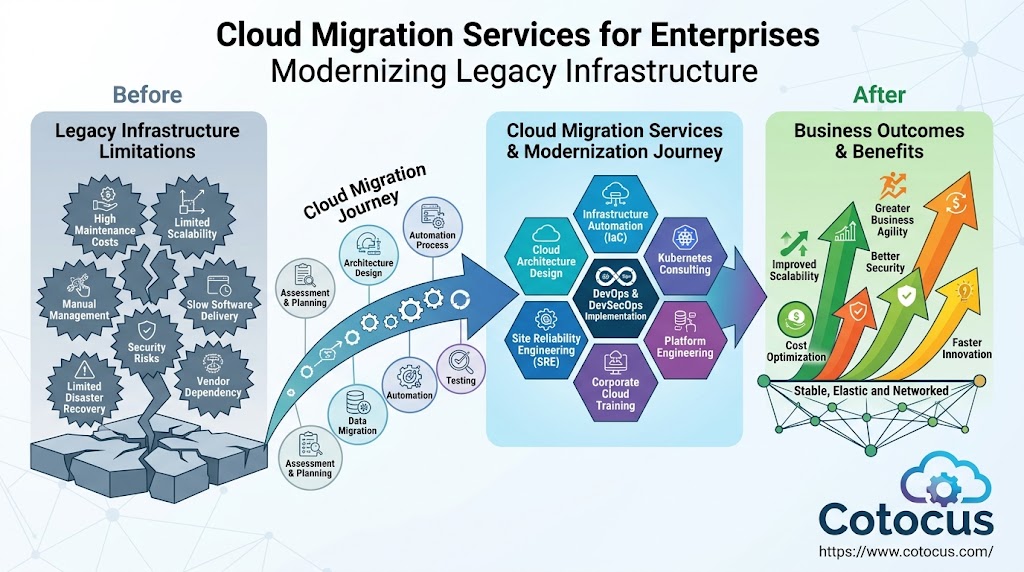
Cotocus helps enterprises modernize legacy infrastructure through professional cloud migration consulting, cloud architecture design, infrastructure automation, Kubernetes consulting, DevOps implementation, DevSecOps, Site Reliability Engineering (SRE), platform engineering, and corporate training. Organizations planning their cloud transformation journey can learn more by visiting https://www.cotocus.com/.
Why Legacy Infrastructure Limits Business Growth
Many enterprises continue to rely on legacy applications and aging infrastructure that were designed for a different era of technology. While these systems may continue to function, they often create challenges that slow innovation and increase operational complexity.
Common limitations include:
- High infrastructure maintenance costs
- Limited scalability
- Manual infrastructure management
- Slow software deployment
- Difficulty integrating modern applications
- Increasing security risks
- Limited disaster recovery capabilities
- Reduced operational flexibility
- Vendor dependency on outdated technologies
These challenges make it difficult for organizations to respond quickly to changing market demands.
Understanding Cloud Migration Services
Cloud Migration Services help organizations transition workloads, applications, databases, and infrastructure from legacy environments to modern cloud platforms. The objective is not simply to relocate systems but to improve performance, reliability, security, and operational efficiency.
A comprehensive migration strategy typically includes:
- Infrastructure assessment
- Application dependency analysis
- Cloud readiness evaluation
- Migration roadmap development
- Cloud architecture design
- Security planning
- Data migration
- Infrastructure automation
- Testing and validation
- Post-migration optimization
Each migration project is tailored to the organization’s technical landscape and business goals.
Benefits of Cloud Migration for Enterprises
Moving to the cloud provides significant business and operational advantages.
Improved Scalability
Cloud platforms allow organizations to scale infrastructure resources based on demand without investing in additional physical hardware.
Greater Business Agility
Development teams can provision environments quickly, reducing delays in software delivery and innovation.
Cost Optimization
Organizations shift from capital-intensive infrastructure investments to more flexible operational spending while improving resource utilization.
Enhanced Reliability
Cloud providers offer high availability features that improve application uptime and business continuity.
Better Security
Modern cloud environments include advanced identity management, encryption, monitoring, and compliance capabilities.
Faster Innovation
Cloud-native technologies enable organizations to adopt automation, containers, serverless computing, and AI-driven services more efficiently.
Developing a Cloud Migration Strategy
Successful cloud migration requires careful planning rather than simply moving existing infrastructure to a new environment.
Infrastructure Assessment
Consultants evaluate servers, applications, databases, storage, networking, and operational processes to understand the current environment.
Application Prioritization
Not every application requires the same migration approach. Workloads are categorized based on complexity, business value, and technical requirements.
Migration Planning
Organizations define migration phases, timelines, resource allocation, risk management strategies, and rollback plans.
Security Assessment
Security controls, identity management, compliance requirements, and data protection strategies are incorporated throughout the migration process.
Cloud-Native Architecture
Cloud migration provides an opportunity to modernize application architecture instead of simply replicating existing environments.
Cloud-native architecture emphasizes:
- Microservices
- Containers
- Kubernetes
- API-driven integration
- Elastic infrastructure
- High availability
- Automated scaling
These architectural improvements enable organizations to build more resilient and flexible applications.
Infrastructure Automation
Automation plays a central role in modern cloud environments.
Infrastructure Automation enables organizations to:
- Provision environments consistently
- Reduce manual configuration
- Improve deployment speed
- Maintain environment consistency
- Simplify disaster recovery
- Improve governance
Infrastructure as Code (IaC) ensures that cloud environments remain repeatable, secure, and version-controlled.
DevOps and Cloud Migration
Cloud migration and DevOps complement each other by improving software delivery and operational efficiency.
DevOps practices support migration through:
- Continuous Integration
- Continuous Delivery
- Automated deployments
- Infrastructure automation
- Monitoring
- Release management
- Collaboration across teams
Combining cloud migration with DevOps helps organizations achieve faster software releases while maintaining operational stability.
Kubernetes for Modern Cloud Workloads
Containerized applications have become a standard deployment model for cloud-native software.
Kubernetes provides:
- Container orchestration
- Automatic scaling
- Service discovery
- High availability
- Resource optimization
- Simplified workload management
Cloud migration projects often include Kubernetes implementation to improve application portability and operational consistency.
Security Throughout the Migration Journey
Security should remain a priority before, during, and after migration.
Important security considerations include:
- Identity and access management
- Data encryption
- Network segmentation
- Secure application deployment
- Vulnerability management
- Compliance monitoring
- Secrets management
- Continuous security validation
Integrating DevSecOps practices helps organizations maintain strong security without slowing migration progress.
Monitoring and Site Reliability Engineering
Cloud environments require continuous visibility into application performance and infrastructure health.
Site Reliability Engineering (SRE) practices help organizations improve:
- Monitoring
- Observability
- Incident response
- Capacity planning
- Service reliability
- Performance optimization
Proactive monitoring enables teams to identify issues before they impact business operations.
Platform Engineering and Developer Productivity
Platform engineering simplifies cloud adoption by creating standardized internal platforms that improve developer experience.
Benefits include:
- Self-service infrastructure
- Standardized environments
- Faster onboarding
- Reduced operational complexity
- Consistent governance
- Improved deployment efficiency
Platform engineering allows development teams to focus on delivering business value rather than managing infrastructure.
Corporate Cloud Training
Technology transformation succeeds when employees understand how to use modern cloud platforms effectively.
Enterprise cloud training often includes:
- Cloud fundamentals
- DevOps practices
- Kubernetes
- Infrastructure as Code
- Cloud security
- Automation
- CI/CD pipelines
- Monitoring
- DevSecOps
- Site Reliability Engineering
Practical training helps organizations build internal expertise and maximize the value of cloud investments.
Business Outcomes of Cloud Migration
Organizations that successfully modernize legacy infrastructure often experience measurable improvements.
| Legacy Infrastructure | Modern Cloud Environment |
|---|---|
| Fixed hardware capacity | Elastic cloud scalability |
| Manual infrastructure management | Infrastructure automation |
| Slow provisioning | Rapid environment deployment |
| High capital expenditure | Flexible operational costs |
| Limited disaster recovery | Built-in resilience and backup |
| Manual software deployments | Automated CI/CD pipelines |
| Limited operational visibility | Centralized monitoring and observability |
| Difficult scaling | Cloud-native scalability |
| Siloed operations | Collaborative DevOps practices |
Why Enterprises Choose Cotocus
Cloud migration is a strategic initiative that requires technical expertise, careful planning, and practical implementation experience.
Cotocus supports organizations through every stage of the cloud modernization journey, from readiness assessments and migration planning to DevOps implementation, Kubernetes adoption, infrastructure automation, DevSecOps integration, Site Reliability Engineering, platform engineering, and enterprise corporate training. By combining consulting with knowledge transfer, Cotocus helps businesses build sustainable cloud capabilities that support long-term digital transformation.
Frequently Asked Questions
What are Cloud Migration Services?
Cloud Migration Services help organizations move applications, infrastructure, and data from legacy environments to modern cloud platforms while improving scalability, security, and operational efficiency.
Why should enterprises migrate to the cloud?
Cloud migration enables organizations to reduce infrastructure costs, improve flexibility, strengthen security, accelerate software delivery, and support business growth.
How long does cloud migration take?
The timeline depends on the size of the environment, application complexity, migration strategy, and business requirements. A phased approach is often recommended.
What is cloud readiness assessment?
A cloud readiness assessment evaluates existing infrastructure, applications, security, dependencies, and operational processes to determine migration suitability.
How does DevOps support cloud migration?
DevOps introduces automation, CI/CD pipelines, Infrastructure as Code, and collaborative workflows that simplify migration and improve operational efficiency.
Why is Kubernetes important in cloud migration?
Kubernetes provides container orchestration, application portability, automated scaling, and operational consistency across cloud environments.
How is security managed during migration?
Security includes identity management, encryption, compliance validation, vulnerability management, network security, and DevSecOps integration throughout the migration lifecycle.
What is Infrastructure as Code?
Infrastructure as Code uses version-controlled templates to automate cloud infrastructure provisioning, improving consistency and reducing manual errors.
Why is enterprise cloud training important?
Corporate training helps IT teams develop the practical skills required to manage cloud platforms, automation, Kubernetes, security, and modern operational practices.
Why choose Cotocus for cloud migration?
Cotocus combines cloud consulting expertise, DevOps implementation, Kubernetes services, infrastructure automation, DevSecOps, Site Reliability Engineering, platform engineering, and enterprise training to help organizations modernize legacy infrastructure with confidence.
Conclusion
Cloud Migration Services provide enterprises with a strategic path toward modernizing legacy infrastructure, improving operational efficiency, and supporting long-term digital transformation. By combining cloud-native architecture, DevOps, automation, Kubernetes, security, and Site Reliability Engineering, organizations can create scalable technology platforms that meet evolving business demands.
Cotocus partners with enterprises to deliver structured cloud migration consulting, implementation guidance, and corporate training that enable successful modernization initiatives. Whether your organization is planning its first cloud migration or expanding an existing cloud strategy, https://www.cotocus.com/ offers the expertise and services needed to build a secure, scalable, and future-ready IT environment.
