Introduction
Modern software systems are increasingly built on cloud-native architecture, where containers, microservices, and distributed systems dominate production environments. In this landscape, Kubernetes has become the standard for container orchestration, enabling scalable, resilient, and automated application delivery.
However, adopting Kubernetes successfully requires more than installing a cluster. Teams must understand deployment strategies, networking, observability, scaling, security, and production operations.
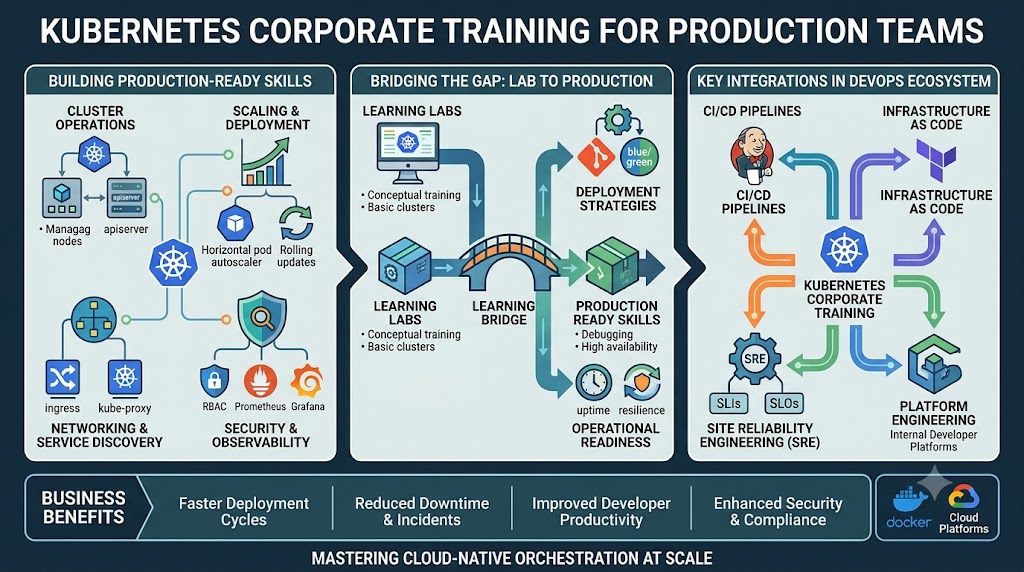
This is where Kubernetes Corporate Training becomes essential. It helps engineering teams move beyond basic usage and build production-ready skills that directly impact system reliability, uptime, and delivery efficiency.
Enterprises today need structured learning that combines theory with real-world engineering practices—not just tool knowledge but operational readiness.
Who Is Rajesh Kumar?
Rajesh Kumar is an experienced DevOps and cloud engineering professional focused on helping organizations adopt modern engineering practices such as Kubernetes, DevOps automation, SRE, DevSecOps, and platform engineering.
His work emphasizes real production challenges, including scalability, reliability, CI/CD integration, and cloud-native architecture design.
He supports engineering teams in strengthening capabilities across:
- Kubernetes cluster operations
- CI/CD pipeline integration
- Infrastructure automation
- Cloud migration strategies
- DevOps and SRE transformation
More details are available at: https://www.rajeshkumar.xyz/
Rajesh Kumar DevOps Consulting & Training
Why Organizations Need Kubernetes Corporate Training
Many organizations adopt Kubernetes but struggle to use it effectively in production environments. Without proper training, teams often face:
- Misconfigured clusters
- Deployment failures
- Lack of monitoring and observability
- Inefficient scaling strategies
- Security vulnerabilities
Kubernetes Corporate Training ensures teams gain practical skills in:
- Cluster architecture and management
- Workload deployment strategies
- Networking and service discovery
- Storage and persistence
- Production troubleshooting
This training is especially critical for teams moving from virtual machines or monolithic systems to containerized environments.
DevOps Context Behind Kubernetes Adoption
Kubernetes does not work in isolation. It is part of a broader DevOps ecosystem that includes:
- CI/CD pipelines
- Infrastructure as Code (IaC)
- Monitoring and logging systems
- Cloud infrastructure platforms
Without understanding this ecosystem, teams struggle to operationalize Kubernetes effectively.
A structured training approach ensures alignment between development, operations, and platform teams, making Kubernetes adoption smoother and more reliable.
Kubernetes Trainer for Enterprise Learning Needs
A skilled Kubernetes Trainer helps bridge the gap between theory and real-world usage. Instead of just explaining concepts, the focus is on:
- Hands-on cluster operations
- Real deployment scenarios
- Debugging production issues
- Scaling applications under load
- Security best practices
This approach helps engineers gain confidence in handling Kubernetes in live production environments rather than just lab setups.
Docker Kubernetes Training for Cloud-Native Readiness
Before mastering Kubernetes, teams must understand containerization fundamentals.
Docker Kubernetes Training typically includes:
- Container lifecycle management
- Image creation and optimization
- Multi-container application design
- Kubernetes pod architecture
- Service exposure and networking
This combination ensures engineers understand both container creation and orchestration at scale.
Kubernetes Corporate Training for Production Systems
Production environments require stability, security, and observability. Kubernetes training for corporate teams focuses on:
- High availability cluster setup
- Rolling updates and rollback strategies
- Resource management (CPU, memory limits)
- Load balancing and autoscaling
- Logging and monitoring integration
The goal is to prepare teams for real-world production scenarios where downtime and misconfigurations can have business impact.
DevOps Consultant Perspective on Kubernetes
A DevOps Consultant plays a key role in ensuring Kubernetes adoption aligns with business objectives.
This includes:
- Designing CI/CD pipelines for Kubernetes deployments
- Integrating GitOps workflows
- Automating infrastructure provisioning using Terraform
- Improving deployment frequency and reliability
Rather than just teaching Kubernetes, consulting ensures it becomes part of a larger engineering transformation strategy.
SRE Principles in Kubernetes Environments
Kubernetes and Site Reliability Engineering (SRE) work closely together.
Key SRE practices include:
- Defining SLIs and SLOs
- Monitoring system health and performance
- Automating incident response
- Managing error budgets
- Ensuring system resilience under failure
These practices help teams maintain production stability while continuing to release features quickly.
DevSecOps in Kubernetes Training
Security is a critical part of Kubernetes operations. A modern DevSecOps Trainer ensures security is integrated into every stage of the lifecycle.
Key areas include:
- Secure container images
- Role-based access control (RBAC)
- Secrets management
- Vulnerability scanning in CI/CD pipelines
- Network policies for secure communication
This ensures Kubernetes environments remain secure and compliant in enterprise setups.
Platform Engineering and Kubernetes
Platform engineering helps organizations simplify and scale developer workflows.
In Kubernetes environments, this includes:
- Internal developer platforms (IDPs)
- Standardized deployment templates
- Self-service infrastructure provisioning
- CI/CD automation layers
A Platform Engineering Consultant helps reduce complexity and improve developer productivity at scale.
Cloud DevOps Integration with Kubernetes
Kubernetes is widely used in cloud environments like AWS, Azure, and GCP.
A Cloud DevOps Consultant helps teams:
- Deploy Kubernetes clusters on cloud platforms
- Manage infrastructure using IaC tools
- Optimize cloud costs
- Implement multi-region deployments
- Ensure scalability and resilience
This ensures Kubernetes aligns with modern cloud-native strategies.
Tools and Technologies Covered
| Area | Tools / Topics | Business Value |
|---|---|---|
| Containers | Docker Kubernetes Training | Scalable application deployment |
| CI/CD | Jenkins Training | Automated release pipelines |
| Infrastructure | Terraform Training | Infrastructure automation |
| GitOps | GitOps Training | Declarative deployments |
| Cloud | AWS DevOps | Cloud-native scalability |
| Monitoring | Observability tools | System visibility and alerting |
| Security | DevSecOps | Secure application delivery |
| Reliability | SRE practices | Improved uptime and resilience |
| Platform | Platform Engineering | Developer productivity boost |
| Delivery | CI/CD Pipeline Training | Faster software releases |
Why Choose Kubernetes Corporate Training
Organizations choose structured training because it provides:
- Hands-on production experience
- Reduced deployment failures
- Improved team collaboration
- Faster cloud adoption
- Better system reliability
- Stronger security practices
- Scalable engineering workflows
It transforms Kubernetes from a complex tool into a well-managed production platform.
Best Fit Audience
Kubernetes Corporate Training is ideal for:
- DevOps engineers
- Cloud engineers
- Software developers
- SRE teams
- Platform engineering teams
- IT operations teams
- Enterprise architecture teams
- Startup engineering teams
It is especially useful for teams transitioning to cloud-native systems.
Business Benefits of Kubernetes Training
Organizations investing in Kubernetes training experience:
- Faster application deployment cycles
- Reduced downtime and incidents
- Improved scalability under load
- Better infrastructure automation
- Enhanced security and compliance
- Optimized cloud resource usage
- Improved developer productivity
- Stronger production stability
These improvements directly impact business agility and operational efficiency.
FAQs
Why is Kubernetes Corporate Training important?
It helps teams gain production-ready skills in deploying, scaling, and managing containerized applications effectively.
What does a Kubernetes Trainer focus on?
A Kubernetes Trainer focuses on hands-on learning, cluster operations, deployment strategies, and troubleshooting in real environments.
Who should attend Kubernetes Corporate Training?
DevOps engineers, cloud engineers, developers, and SRE teams working with containerized systems should attend.
How does Kubernetes help in production environments?
It improves scalability, automates deployments, and ensures high availability of applications.
Why is Docker Kubernetes Training important?
It builds foundational knowledge of containerization and orchestration needed for cloud-native systems.
Conclusion
Kubernetes has become the backbone of modern cloud-native infrastructure, but its real value is unlocked only when teams are properly trained to use it in production environments.
Structured Kubernetes Corporate Training ensures engineering teams understand not only how Kubernetes works, but how to operate it reliably at scale with DevOps, SRE, DevSecOps, and platform engineering practices.
Organizations looking to strengthen their cloud-native capabilities can explore expert-led training and consulting at:
https://www.rajeshkumar.xyz/
With the right guidance, Kubernetes becomes not just a tool—but a foundation for scalable, resilient, and production-ready engineering systems.
